https://www.futurelearn.com/info/blog/why-is-digital-marketing-important-for-business
In the modern business landscape, launching a new venture is both an exciting opportunity and a formidable challenge. The old rulebooks of commerce have been completely rewritten. Decades ago, a new business relied heavily on physical storefronts, local print advertisements, radio spots, or word-of-mouth recommendations to build a customer base. Today, the marketplace exists primarily online.
For a new business, establishing a robust digital presence is no longer an optional luxury or a secondary strategy to be considered down the line. It is the cornerstone of survival, growth, and long-term scalability. Digital marketing provides early-stage companies with the tools, data, and platforms necessary to compete with established industry giants.
Starting a new business is exciting, but it also comes with many challenges. New businesses need to attract customers, build a strong brand, compete with established companies, and generate sales—all while working with limited resources. In today’s digital age, digital marketing has become one of the most effective ways for new businesses to overcome these challenges. It allows businesses to reach potential customers, promote their products and services, and build lasting relationships with their audience.
Digital marketing refers to the promotion of products or services through digital channels such as search engines, social media, websites, email, online advertisements, and mobile applications. Unlike traditional marketing, digital marketing provides businesses with the opportunity to reach a large audience at a relatively low cost. This makes it particularly valuable for startups and small businesses.
1. Cost-Effective Marketing
One of the biggest advantages of digital marketing for a new business is its affordability. Traditional advertising methods such as television commercials, newspapers, billboards, and magazines can require a large budget. A new business may not have enough money to invest in these expensive methods.
Digital marketing provides more affordable alternatives. Businesses can create social media accounts, publish useful content, send emails, and optimize their websites for search engines without spending a huge amount of money. Even paid advertising can be started with a small budget and increased gradually as the business grows.
For example, a small clothing business can promote its products through social media platforms and targeted online advertisements instead of paying for an expensive television advertisement. This allows the business to use its limited marketing budget more efficiently.
2. Reaching the Right Audience
Another major benefit of digital marketing is the ability to target specific groups of people. Traditional advertising often reaches a broad audience, including many people who may have no interest in the product or service.
Digital marketing allows businesses to target customers based on factors such as age, location, interests, online behavior, and purchasing preferences. This means a new business can focus its marketing efforts on people who are more likely to become customers.
For instance, a local bakery can use online advertising to reach people living within a particular area who are interested in food, desserts, or special occasions. By reaching the right audience, the business can improve its chances of generating sales.
3. Building Brand Awareness
For a new business, creating brand awareness is extremely important. Customers are more likely to buy from a business they recognize and trust. Digital marketing provides many opportunities for new businesses to introduce their brand to potential customers. A business can use its website, social media pages, videos, blogs, and other forms of online content to communicate its values and showcase its products or services. Consistent online activity helps customers become familiar with the brand.
Social media is particularly useful for this purpose. By regularly sharing interesting, educational, entertaining, or informative content, a new business can gradually develop a recognizable identity and attract a loyal audience.
4. Competing With Established Businesses
New businesses often have to compete with companies that have been operating for many years and have larger budgets. Digital marketing can help reduce this disadvantage.
A small business does not necessarily need a huge marketing budget to compete online. By producing high-quality content, understanding its target audience, improving its website, and maintaining an active social media presence, a new business can attract customers and gain visibility.
Search engine optimization (SEO) is especially useful. By creating valuable content and optimizing a website for relevant search terms, a small business can improve its chances of appearing when potential customers search online for related products or services.
5. Increasing Customer Engagement
Digital marketing is not only about selling products. It is also about building relationships with customers. Social media, email, online reviews, and messaging platforms allow businesses to communicate directly with their audience.
Customers can ask questions, provide feedback, leave reviews, and interact with the business. In response, businesses can address concerns and provide helpful information.
This two-way communication can make customers feel valued. When customers receive good service and have positive experiences with a brand, they are more likely to return and recommend the business to others.
6. Measuring Marketing Results
One of the most important advantages of digital marketing is that its results can be measured. Traditional marketing methods can make it difficult to determine exactly how many people saw an advertisement or how many customers it generated.
Digital marketing provides businesses with useful information about their campaigns. They can track website visits, social media engagement, advertisement clicks, leads, conversions, and other performance indicators.
This information helps new businesses understand what is working and what needs improvement. If a particular advertisement is not producing results, the business can change its message, audience, or budget. This ability to make quick adjustments can save money and improve marketing performance.
7. Increasing Sales and Business Growth
The ultimate goal of marketing is often to generate sales and support business growth. Digital marketing can help businesses guide potential customers through the buying process.
For example, a customer may discover a business through a social media post, visit its website to learn more, read customer reviews, and then make a purchase online. Digital marketing can support each stage of this journey.
Businesses can also use email marketing, remarketing, special offers, and personalized content to encourage existing customers to make additional purchases. As a result, digital marketing can contribute to both customer acquisition and customer retention.
8. Creating a Strong Online Presence
Today, many people search online before purchasing a product or using a service. If a new business does not have a strong online presence, potential customers may have difficulty finding or trusting it.
A professional website, active social media profiles, accurate business information, and positive online reviews can help establish credibility. A strong online presence also allows customers to learn about a business at any time.
For a new company, this can be particularly important because customers may be unfamiliar with the brand. Providing useful and trustworthy information online can help build confidence.
9. Flexibility and Quick Changes
Digital marketing is highly flexible. New businesses can experiment with different types of content, advertisements, platforms, and strategies. If something does not work, changes can usually be made quickly.
For example, a business may discover that short videos generate more engagement than traditional posts. It can then adjust its content strategy accordingly. This flexibility allows businesses to learn from their audience and continuously improve their marketing efforts.
10. Building Long-Term Customer Relationships
Successful businesses need more than one-time customers. They need loyal customers who return and recommend their products or services to others. Digital marketing can help create these long-term relationships.
Businesses can stay connected with customers through newsletters, social media updates, personalized offers, helpful content, and customer support. By consistently providing value instead of focusing only on sales, a business can develop trust and loyalty over time.
Conclusion
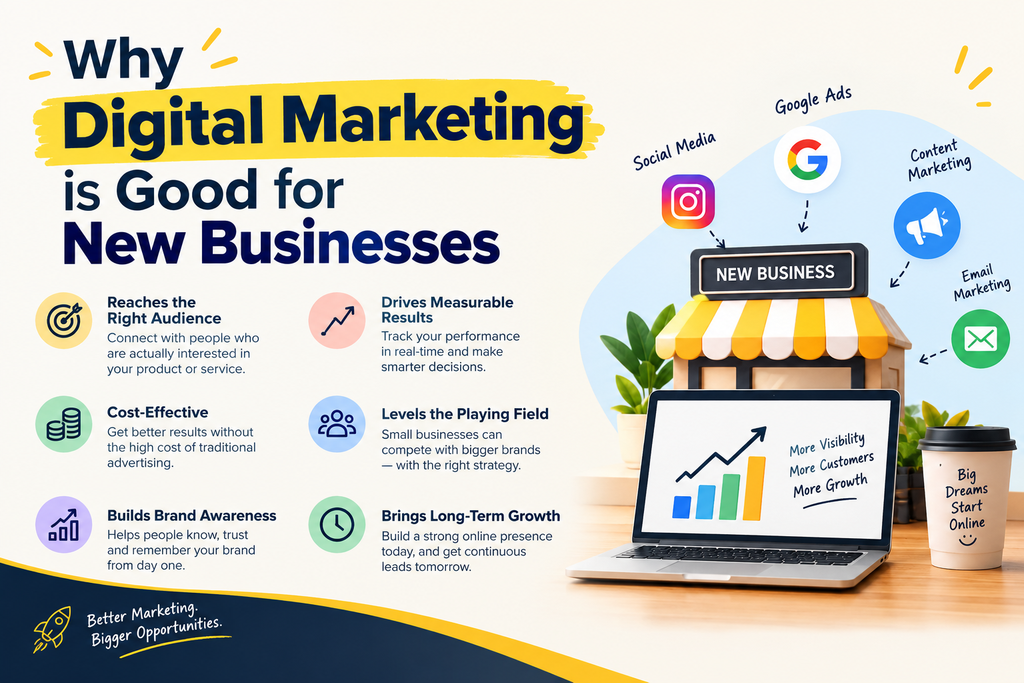
Digital marketing is a powerful tool for new businesses because it provides affordable, targeted, measurable, and flexible ways to reach customers. It can help startups build brand awareness, compete with larger companies, increase sales, engage with customers, and establish a strong online presence.
However, digital marketing is most effective when it is approached strategically. Businesses should understand their target audience, choose suitable digital channels, create valuable content, monitor results, and continuously improve their strategies.
In a competitive business environment, having a good product or service is only the beginning. A business also needs to make people aware of what it offers and give them a reason to choose it. Digital marketing provides new businesses with the tools to do exactly that. With consistent effort and a customer-focused approach, it can become an important foundation for long-term business success.