Meta ads or google ads
Every digital marketer, founder, and business owner eventually hits the same crossroads. You open your advertising dashboard, look at your budget, and ask the million-dollar question: Should I spend my money on Meta Ads or Google Ads?
The debate between meta ads or google ads and profitable strategy is as old as modern performance marketing itself. One platform thrives on interruptive discovery, while the other captures immediate intent. Picking the wrong one—or deploying them incorrectly—is the fastest way to burn through your capital with zero return. Achieving profitability pisn’t about declaring one platform a permanent winner. It is about understanding how buyer psychology differs on each network and architecting a unified funnel that turns clicks into cash.
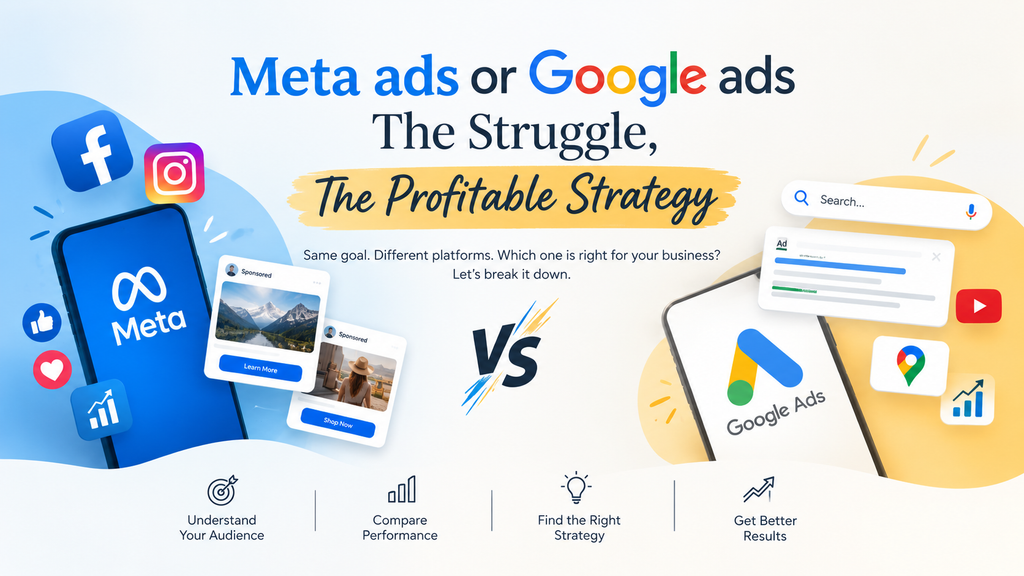
The Core Behavioral Divide: Intent vs. Discovery
To build a profitable strategy, you must first understand why users behave differently on Google and Meta.
Google Ads (Capturing Demand): When a user opens Google, they are on a mission. They type phrases like “best CRM software for small business” or “emergency plumber near me”. They have an active problem, high commercial intent, and are ready to transact. Google doesn’t need to convince them that they need a solution; it just needs to position your business as the best answer.
Meta Ads (Creating Demand): When a user opens Facebook or Instagram, they are looking to relax, catch up with friends, or watch Reels. They are not actively searching for a product. Meta Ads interrupt their feed experience. Success here relies on thumb-stopping creative, emotional resonance, and visual storytelling that transforms passive scrollers into active buyers.
Platform Strengths: When to Use Which
Basing your budget allocation on gut feelings is a fast track to financial loss. Each platform plays a distinct role in the customer journey.
Why Choose Meta Ads?Meta dominates top-of-funnel discovery. If you are selling a visually striking product—such as apparel, beauty items, home decor, or lifestyle accessories—Meta’s algorithmic targeting (especially Advantage+ campaigns) excels at finding people who match your buyer persona before they even search for you. It is also unmatched for scaling brand awareness quickly due to its massive reach and lower cost-per-impression (CPM).
Why Choose Google Ads?Google captures the bottom of the funnel. If your business relies on high-urgency services (legal, medical, SaaS, emergency repairs, or high-ticket B2B solutions), Google Search and Performance Max campaigns put you directly in front of buyers at the exact moment of decision
Building a Profitable Strategy: The Dual-Engine Approach
The most profitable strategy is rarely choosing either Meta or Google. Instead, it is combining them into a cohesive ecosystem where Meta creates the demand and Google captures it.
Meta Ads: Top-of-Funnel ] │ (Creates awareness & sparks emotional interest) ▼[ Brand Consideration ] │ (User remembers product, opens Google later) ▼[ Google Search: Bottom-of-Funnel ] │ (Captures high-intent branded
4. Key Pillars of Ad Profitability
Even with the right channel mix, campaigns fail without rigorous financial hygiene. To keep your ad spend profitable, focus on three strict rules:Track Blended ROAS, Not Just Platform ROAS: Both Meta and Google love taking credit for the same sale. A customer might see your Instagram ad, sleep on it, and later click a Google search ad to purchase. Use neutral analytics platforms (like GA4) to view your Blended Return on Ad Spend (ROAS) across all channels. Optimize for Lifetime Value (LTV), Not Just CPA: A cheap cost-per-acquisition (CPA) on Meta is useless if those customers never buy again and churn immediately. Conversely, a high-cost click on Google might acquire a high-ticket enterprise client with an incredible Customer Lifetime Value. Creative Refresh is Non-Negotiable: Meta ad fatigue sets in rapidly. Stale creatives destroy profitability through rising CPMs. Build a systematic pipeline to test new hooks, angles, and video edits weekly.